El Tabo
El Tabo has many beaches, which are: "Larga", "7 Reales", "Caleuche", "Chepica" and "El Tabito", the last one is a big beach, good for bathing.
The Church of the place is located next to the road, and this divide the town into two parts.
In El Tabo you can find restaurants, beautiful forests and also a Cultural House, the last one was inaugurated in 1995. Following the coastal road, going south, near "Las Cruces" there is a place called "El Peral" Lake, this site is important due to its environmental value, "El Peral" Lake has black necked swans, "pataguas", herons and others birds. This place was declared Sanctuary of Nature, in order to protect and preserve beautiful and endangered species.
Nowadays, El Tabo has 4.500 inhabitants, but in summer the total population more than double.

Las Cruces
In El Tabo County there is a resort called Las Cruces, which is located between two hills, and in each one there are big houses. Las Cruces is divided into two neighbourhoods, one called "Barrio Vaticano" and the other "Barrio Quirinal", both neighbourhoods are very different between them. In "Barrio Vaticano" life begins very early in the morning, and the inhabitants in this place like to go to the beaches and bathing in "Los Pescadores" o "Las Salinas", to later go to mass in the church nearby. On the other hand, in "Barrio Quirinal" life begins very late, and their inhabitants enjoying going to "Blanca" Beach and later gathering for a drink or just a talk
Some of the oldest constructions that remain in the place are the Black Castle, built by Hector Hernandez and the town Church.
In this Resort lived for some months of the year the famous poet Nicanor Parra. In Las Cruces beaches are: "Chica", "Blanca", "Los Pescadores" and "Las Salinas".
Cartagena
This is a very well known Resort located 7 kilometres north of San Antonio, 97 kilometres south of Valparaiso and 108 kilometres west of Santiago, the capital of Chile.
Cartagena has a mild warm weather and the area present an abrupt relief.
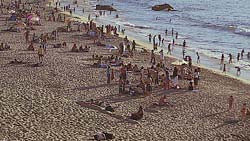
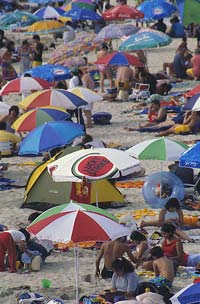
Beaches here present very calm water. Cartagena has two beaches "Playa Chica" and "Playa Grande", and both are very crowded and a popular destination in summer. Nowadays, these are centres of gathering and recreation.
In 1615, these lands were donated to Juan de Cartagena y Rodríguez, who received these as grant of land by the Spanish Crown.
In the XVII century Cartagena was used as a Port. Later on, in 1790, this Port was used as an "Exporting and Importing Port".
At the end of the XIX century, Cartagena was an exclusive resort, especially for the aristocracy. Many rich families of the time were invited by the Huidobro's family (a rich family from Santiago), to settle and built their summer houses in this place and they do so. Many of those ostentatious houses still remain and can be seen in Cartagena today.
Later on, the Santiago - Cartagena railroad was built and the area was more accessible from Santiago.
Nowadays, Cartagena is a very popular place, in summer streets and beaches are very crowded, and as a defying history, by low class Chilean society.
One of the most notorious citizens of Cartagena was the famous poet Vicente Huidobro. He always loved Cartagena, and as it's was his desire, he was buried here.
San Antonio
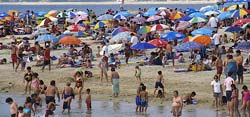
The history of San Antonio Port begins in 1865, during the war with Spain and the blockade of Spanish ships to Valparaiso Port. This fact helped San Antonio to become a Port for exports and imports together with Valparaiso. Nevertheless, the most important factor was that construction of the Santiago - San Antonio railroad in 1911. The Port of San Antonio was inaugurated in 1917.
The city of San Antonio is located in the hillside of "La Virgen" Hill, also well known as "Centinela".
San Antonio has many restaurants, shops, market ("Mercado"), services and many attractions for enjoying night life.
San Antonio has a central square, located in the down town. One of the main attractions for walking and just going around is the "Paseo Bellamar" (beautiful sea Promenade).
Another worth seen place in this area is the National Monument "Grúa 82". This is an old and great crane brought from France in 1911.This facility was used in the actual (Crane 82) construction of the Port of San Antonio and continues to provide services for the port.
It is also recommended to visit the Municipal Museum of Natural Sciences and Archeology. The museum keeps many collections, archeological pieces and, as part of the museum, the Department of Rescue and Rehabilitation of Wild Fauna.
San Antonio is the most important urban centre in the south coast of Valparaiso Region, providing a wide range of services for import and export activities as well as for weekend leisure of people coming from Santiago and other inland urban centres.
Llo Lleo
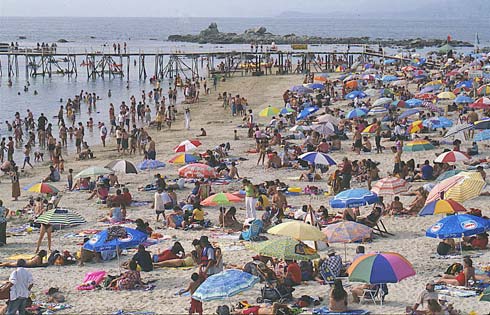
This small sea shore town is located 4 kilometres south of San Antonio. Llolleo started to have importance, when it was connected to Santiago by railroad (an extention of the line Santiago - San Antonio), and when big and beautiful houses with pretty gardens were built for summer vacation of inland people.
Llolleo is a quiet place with a micro climate, the principal characteristic of this climate is that is said to be good for heart diseases, that is the reason why this city is known as "Llolleo: the heart's city".
In Llolleo you can find pubs, bars and discotheques.
The square of this place is known as "La plaza del Folclor", because every Sunday here there are musical presentations.
Llolleo is an urban resort, but it has rural areas called "Lo Gallardo", "San Juan" and "Cuncumén".

Rocas de Santo Domingo
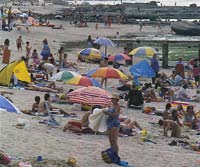
Rocas de Santo Domingo is located in a small hill in the south bank of Maipo River. This County is divided into two areas, the urban area, where Rocas de Santo Domingo Resort is located, and the rural area, its has many places like: "El Convento", "Bucalemu", "San Enrique", "San Guillermo", "Bucalemito", "Salinas", "Portales" and others.
This place has a long beach of 20 kilometres of extension, with dark sands. This beach goes from Rocas de Santo Domingo Resort up to "Punta de Toro" beside the mouth of "Yali" River.
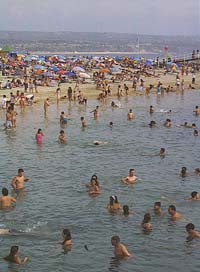
LThe coastal area is quite windy. This area has big dunes formation, marshes and lakes, and also a "salina" (salt mine). The access to this zone can be done only by horse or walking.
Rocas de Santo Domingo is one of the most exclusive resorts at south of Valparaiso Region. This place has beautiful and big houses for summer vacation with big gardens. The streets and squares have lots of green space.
The most important places in Rocas de Santo Domingo are the beach, golf club, school "People Help People", floral square and church.
This place was named "Rocas de Santo Domingo", after the order of Dominicans, who were owner of these lands.
This County in association with the Catholic University of Chile created a new park called "Parque de la Naturaleza". This is a beautiful place of great natural value. Birds come from central and south parts of the country, to this area, to nest and breed.

© 1997 - 2009 TurismoChile.cl |
Phone: 894 72 98 |
Contact